Assimilasjon: Meaning, Process, and Social Impact
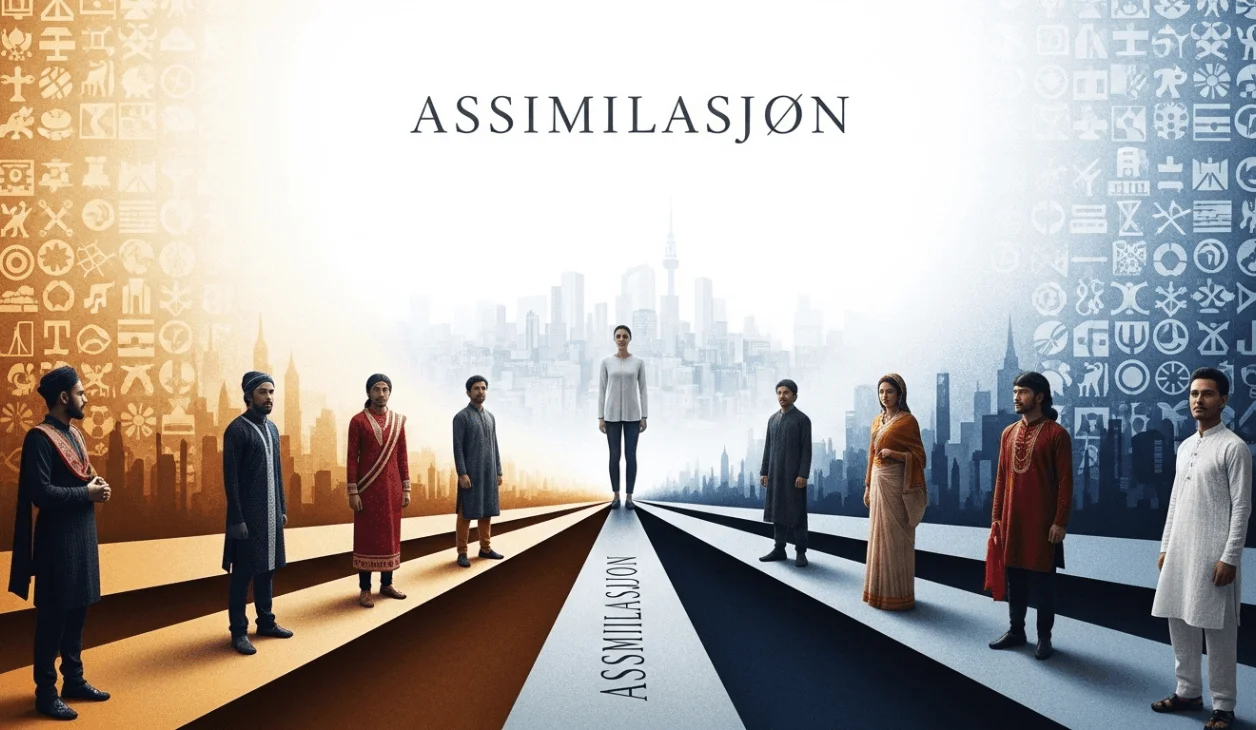
Assimilasjon is a concept widely used in sociology, anthropology, and cultural studies to describe how individuals or groups gradually adopt the cultural traits of another dominant group. In simple terms, assimilasjon refers to the process where minority cultures begin to resemble or fully merge with the majority culture over time. This transformation can happen naturally or through social pressure, and it plays a major role in shaping modern multicultural societies.
In today’s globalized world, assimilasjon is more relevant than ever, as migration, urbanization, and international communication continue to increase. As a result, understanding this process helps us better analyze cultural identity, integration, and social harmony.
What is Assimilasjon?
At its core, assimilasjon describes a social process in which individuals or groups adopt the language, values, customs, and behaviors of another culture. This often happens when immigrants or minority communities settle in a new country and gradually adapt to the dominant cultural norms.
However, assimilasjon is not always a simple or one-way process. While some groups fully integrate into the dominant culture, others may retain parts of their original identity. Therefore, assimilation exists on a spectrum rather than as a fixed outcome.
Moreover, assimilasjon can occur voluntarily or involuntarily. In voluntary cases, individuals choose to adapt in order to improve social mobility or acceptance. In contrast, forced assimilation happens when policies or societal pressure push minorities to abandon their original culture.
Types of Assimilasjon
There are several forms of assimilasjon, each with unique characteristics:
1. Cultural Assimilasjon
This is the most common form, where language, traditions, and daily practices are gradually replaced by those of the dominant culture. For instance, immigrants may start speaking the local language more frequently than their native tongue.
2. Structural Assimilasjon
In this form, individuals gain access to institutions such as schools, workplaces, and political systems. Over time, assimilasjon in this sense leads to equal participation in social structures.
3. Social Assimilasjon
This occurs when people form close relationships—such as friendships or marriages—across cultural boundaries. As a result, assimilasjon becomes more personal and deeply integrated into daily life.
4. Identificational Assimilasjon
Here, individuals begin to identify themselves with the dominant culture, sometimes even replacing their original cultural identity entirely. This is considered the final stage of full assimilasjon.
Factors That Influence Assimilasjon
Several factors determine how quickly or effectively Assimilation takes place. First, language plays a crucial role. Learning the dominant language makes communication easier and accelerates cultural adaptation.
Second, age is an important factor. Younger individuals often experience faster Assimilation because they adapt more easily to new environments. In contrast, older individuals may retain stronger ties to their native culture.
Third, social environment significantly affects the process. Living in diverse communities can slow down Assimilation , while living in more homogeneous societies can speed it up.
Additionally, government policies can either encourage or discourage Assimilation . Some countries promote multiculturalism, while others emphasize complete cultural integration.
Advantages and Disadvantages of Assimilasjon
Like any social process, assimilasjon has both positive and negative aspects.
On the positive side, it can promote unity and social cohesion. When people share common values and language, communication becomes easier, and social conflicts may decrease. Furthermore, Assimilation can help immigrants access better job opportunities and education.
However, there are also drawbacks. One major concern is the loss of cultural diversity. When Assimilation happens too strongly, unique traditions and languages may disappear over time. This can lead to a sense of cultural loss among minority groups.
Moreover, forced Assimilation can create feelings of exclusion or discrimination. Instead of fostering unity, it may lead to resistance and social tension.
Real-World Examples of Assimilasjon
Throughout history, assimilasjon has occurred in many societies. For example, immigrant communities in large cities often adopt the language and lifestyle of the host country within a few generations. Children of immigrants, in particular, tend to experience faster Assimilation through education and social interaction.
Another example can be seen in globalized workplaces, where employees from different cultural backgrounds adapt to corporate norms, communication styles, and professional expectations. In such cases, Assimilation helps create a shared working culture.
At the same time, some communities actively resist full assimilation in order to preserve their cultural heritage. This balance between adaptation and preservation is a key feature of modern multicultural societies.
The Role of Assimilasjon in Modern Society
In contemporary society, assimilasjon continues to be a debated topic. Some argue that it is necessary for national unity and social stability. Others believe that it threatens cultural diversity and encourages conformity.
Nevertheless, many experts suggest a balanced approach. Instead of complete assimilation, they recommend integration, where individuals can participate in society while maintaining their cultural identity. This hybrid model allows for both unity and diversity.
As globalization continues to grow, Assimilation will likely remain an important concept in understanding how societies evolve and interact. It influences not only individuals but also education systems, labor markets, and political structures.
Conclusion
In summary, assimilasjon is a complex and multi-dimensional process that shapes how cultures interact and evolve. It involves the gradual adoption of cultural traits, influenced by language, age, environment, and policy. While it can promote unity and opportunity, it can also lead to cultural loss if not balanced carefully.
Ultimately, understanding assimilasjon helps us better appreciate the delicate relationship between cultural identity and social integration. As societies become increasingly diverse, the challenge is to find a balance that respects both shared values and cultural uniqueness.